
Overtime & pay rules
Your rules, in the order they actually apply
Thresholds and multipliers are yours to set. The order they are applied in is fixed, because that order is what makes the answer the same every time — and the same one your crew would work out by hand.
Try it
Play with the pay engine
The same calculation Costworks runs on every timesheet, starting from the rules it ships with: overtime past 12 hours in a day at ×1.5, Sunday at ×2, a worked bank holiday at ×2, and Saturday and weekly overtime switched off until you switch them on.
The order the rules apply in
Leave is set aside first. Each day’s hours are split at your daily threshold; what is left is banded by the kind of day — bank holiday, Sunday, Saturday or standard; then the weekly threshold is applied to standard hours; and finally every band is priced at the rate in force on the day it was worked. Turn on JavaScript to try it with your own numbers.
What you set
The values are yours, rule by rule
Pay rules lists every rule your firm pays by. Change the threshold, change the multiplier, or switch a rule off. The catch-all standard rule is always there underneath.
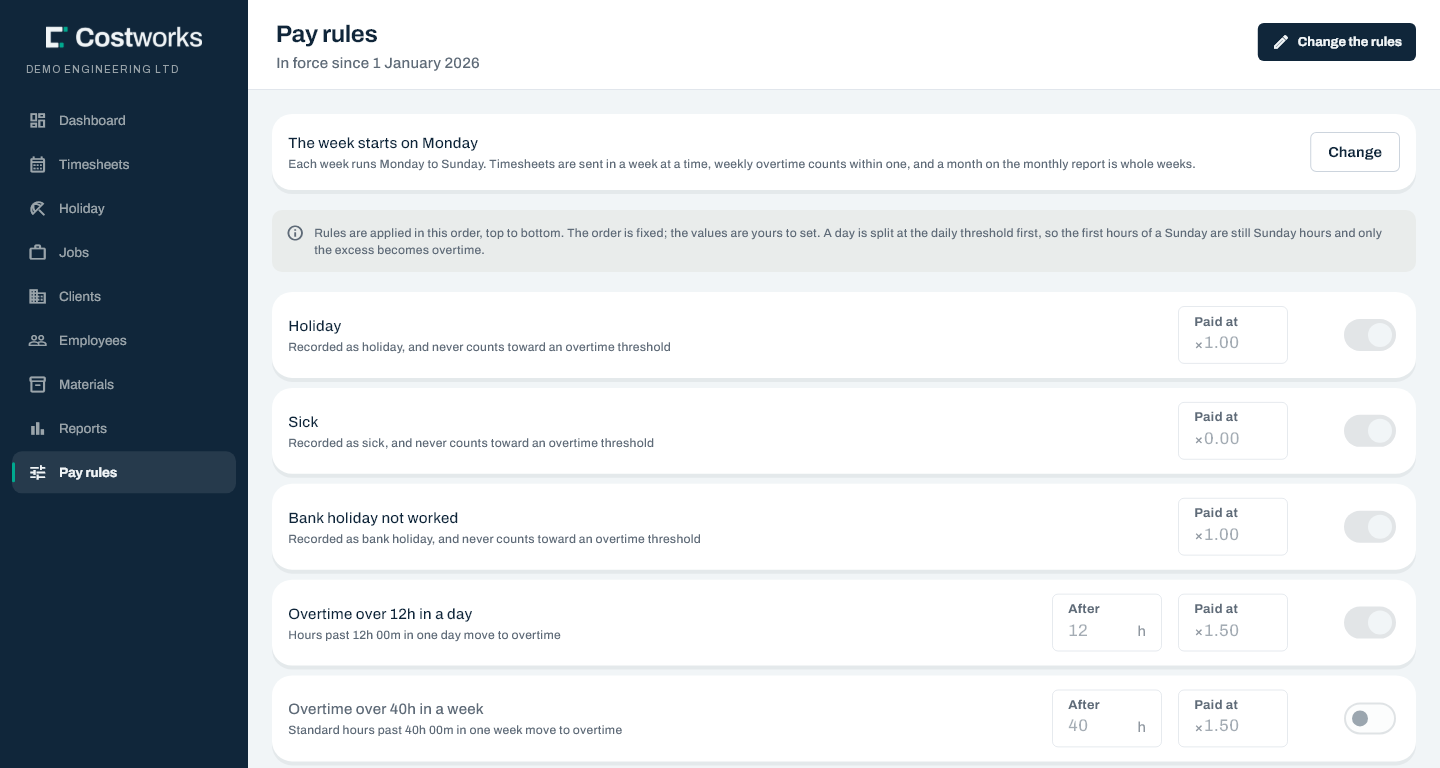
Holiday, sick, bank holiday
Each paid at its own multiplier. Out of the box, holiday and a bank holiday not worked pay ×1, and sick pays nothing.
Daily and weekly
A daily threshold (12 hours out of the box) and a weekly one (40 hours, switched off until you want it), each at its own multiplier.
Saturday, Sunday, bank holiday
A multiplier for each, switched on or off. A bank holiday worked is checked first, ahead of every other kind of day.
Stay-away pay
A set amount for each night away, dated like a pay rate, and counted into gross pay.
A fixed set of rules, honestly. You set the values and switch rules on or off; the office cannot invent a new kind of rule. If your firm pays in a way these do not cover, tell us before you start — that is exactly the conversation worth having.
Dated, never rewritten
A pay question three years from now gets the same answer
Rules and rates both carry the date they start. Nothing is overwritten, so the rate and the rules for any day are the ones that were in force on that day.
Rule changes start from a week
A change is a new version dated forward from a week start, and it is shown as a summary before it saves. If it would re-price a week already approved, it is refused.
Pay rises are one entry
A rise is a new rate with the day it starts, and can be set in advance. Every day is priced at the rate in force that day, so a rise on a Wednesday leaves Monday and Tuesday where they were.
No rate, no guess
A day with no rate yet is counted as unpriced, not priced at £0 or at somebody else’s rate. The dashboard, the board and the report all flag it, and a gross that leaves it out is starred.
Hourly or salaried
Salaried staff record their hours like everybody else and show as Salary rather than being priced by the hour.
The day your week starts
Weeks can start on whichever day your payroll runs from. Changing it moves the hours already recorded into their new weeks, or refuses and names the weeks that are in the way. Changing the week start
Bank holidays built in
The bank holidays for England and Wales are loaded for every new firm, so a worked bank holiday is recognised without anybody marking it.
Questions
About overtime and pay rules
Are the first hours of a Sunday overtime or Sunday hours?
Sunday hours. Each day is split at the daily overtime threshold before the kind of day is looked at, so the hours up to the threshold are paid at the Sunday rate and only the excess becomes overtime.
What happens to old hours when somebody gets a pay rise?
Nothing. A rise is a new rate with the date it starts. Every day is priced at the rate in force on that day, so hours worked before the rise keep their old rate for good, however long afterwards you look.
Can we change the rules part-way through the year?
Yes. A change starts from a week you choose and is shown as a summary before it saves. A change that would re-price a week already approved is refused, so a signed-off week never moves.
Can we add our own kinds of rule?
You set the values and switch each rule on or off: holiday, sick, bank holiday worked and not worked, daily and weekly overtime, Saturday and Sunday. New kinds of rule are not something the office can add; tell us if your firm pays in a way these do not cover.
What if somebody has no rate set?
Their hours are counted but not priced at a guess. They are flagged as unpriced on the dashboard, the board and the report, and a gross that leaves them out is starred.

Bring us your trickiest week
A bank holiday, a long Sunday, a pay rise on a Wednesday. Tell us how you pay it now and we will show you the same answer from Costworks.